The Work You Don’t See: Building Toward 30 Years of Charleston Race Week at Patriot’s Point
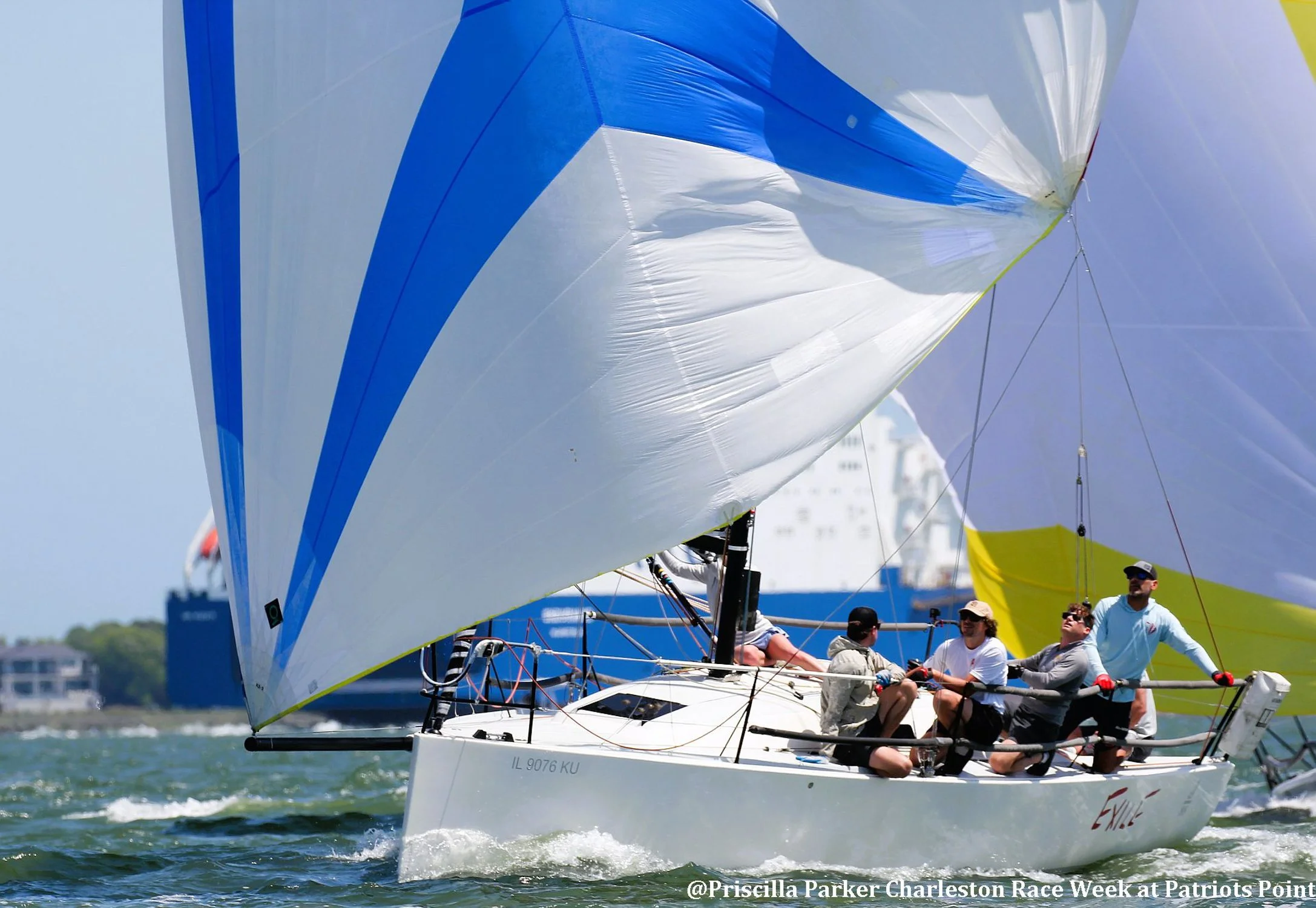
January marks the final month for teams to register early and take advantage of the $100 entry discount, which is available to entries that are fully completed—including the online waiver and entry fee—by January 31, 2026.
Charleston / Mt. Pleasant, SC (January 9, 2026) — In 2026, Charleston Race Week at Patriot’s Point will mark a significant milestone: 30 years of competition, community, and evolution. For most sailors, the experience begins at the dock—registration packets in hand, sails being sorted and selected, practice tuning underway, and race signals echoing across Charleston Harbor. What is far less visible, however, is the months-long process that makes those moments possible.
Charleston Race Week has long been described as a regatta unlike any other, and that distinction is not accidental. It is the product of deliberate planning, constant refinement, and a behind-the-scenes effort that begins well before the first out-of-town boat arrives in Charleston. The event’s reputation has been built not only on scale, but on intention.
“January can set the tone for the entire event,” said Randy Draftz, Executive Director of Charleston Race Week at Patriots Point. “Early registration isn’t just about numbers—it’s about commitment. When teams get on the entry list early, it allows us to start building the regatta the right way. With the early entry period ending January 31, now is the time for teams to get on board and be part of shaping the event from the start.”
Every January, the build-up officially begins. Each week, a detailed race management meeting takes place—methodical, exhaustive, and highly collaborative. These meetings are not ceremonial check-ins; they are working sessions where every aspect of the event is examined, questioned, adjusted, and re-examined. From high-level strategy to the most minute operational detail, nothing is assumed or overlooked.
At the center of this effort is a broad and deeply experienced group of race officials, sailing professionals and passionate volunteers. Executive Director Randy Draftz leads the charge, supported by a dedicated team led by Anna Draftz, whose coordination spans volunteers, food service, registration, check-in logistics, sponsor activation, and on-site operations. This work is closely integrated with Charleston Race Week’s event partner, the Patriot’s Point Naval & Maritime Museum—a venue that brings both opportunity and complexity to hosting an event of this scale.
Beyond the shoreside team, the race management structure is equally robust. Judges are aligned early. Support teams are confirmed. All five Principal Race Officers, along with overall Event PRO Taran Teague, participate in the weekly planning calls, working collectively to shape the racing program as entries evolve. Entry lists are not simply tracked; they actively inform decision-making. As participation grows or shifts, so too does the structure of the event, ensuring competitive balance and meaningful racing across every class—from inshore to offshore, from ORC and PHRF to One Design and back again.
“The earlier we understand who is coming and how the fleets are shaping up, the better racing we can deliver,” said Taran Teague, Event Principal Race Officer. “Entry numbers affect everything—from how many race circles we run, to course geometry, to how we structure distance and inshore racing. Early entries give us the clarity we need to build fair, competitive courses that truly fit the boats and the sailors racing them.”
One of the most distinctive and often overlooked elements of Charleston Race Week’s planning process is its direct engagement with the classes themselves. Draftz and others work closely with class secretaries, administrators, and fleet leadership to ensure that race formats, course design, and scheduling reflect the unique racing styles, expectations, and competitive priorities of each fleet. This class-first approach has long defined the event’s adaptability, providing meaningful options for everything from PHRF boats seeking offshore competition to those preferring inshore racing. That philosophy takes on added significance in 2026 with the continued growth of the ORC category, where thoughtful planning of the Thursday distance race is producing a technically sound, competitive “grand tour” of Charleston Harbor—one that balances distance, conditions, navigational challenges, and tactical decision-making to deliver fair, high-quality racing across the fleet.
And yet, all of this planning extends well beyond the racecourse. Volunteers, both shoreside and on the water are essential, and recruitment begins months in advance. Race committee staffing requires experienced personnel, reliable equipment, and precise coordination. Boats, marks, radios, timing systems, and contingency plans are all accounted for long before they are deployed.
From the competitor’s perspective, Charleston Race Week at Patriot’s Point can feel almost effortless. That is by design. The reality is a carefully constructed framework built on decades of experience, constant communication, and an unwavering commitment to doing things right.
As the calendar rolls onward toward April and the 30th anniversary approaches, the behind-the-scenes work will continue—quietly, deliberately, and relentlessly. It is the foundation that allows Charleston Race Week at Patriot’s Point to remain what it has always been: familiar, evolving, and truly unlike any other regatta on the calendar.
January, however, is not just the start of a new year—it is also a pivotal moment in the lifecycle of Charleston Race Week at Patriots Point. It marks the final month for teams to register early and take advantage of the $100 entry discount, which is available to entries that are fully completed—including the online waiver and entry fee—by January 31, 2026.
In many ways, registering early is a form of participation before the first starting signal ever sounds. It helps ensure that Event Organizers can continue to deliver the level of competition, organization, and experience sailors have come to expect.